| FreescaleHRP | |
|
|

The High Resolution PWM (HRP) provides two complementary outputs for controlling a half bridge in, for example, light ballast applications. It uses a dithering control method to provide a high step resolution (< 4 ns) from an 8 MHz input clock. It also provides a shutdown input that can be used to disable the outputs when a fault condition is detected in the application.
Features of the HRP include the following:
- One complementary output pair for driving a half bridge
- Dithering between two frequencies or duty cycles, for increased output resolution
- Automatic calculation of second frequency for output dithering
- Variable frequency mode with automatic 50% duty cycle calculation
- Variable duty cycle mode
- Programmable dead time insertion
- Shutdown input for fast disabling of outputs
Frequency Dithering Concept
The HRP’s dual frequency generator block generates two complementary output signals which, after dead-time insertion, are routed to the TOP and BOT output pins. It uses a dithering technique to increase the resolution of the output signals. Frequency dithering is a technique that can increase the resolution of an output signal by switching between two closely spaced frequencies. By varying the time spent on each frequency, the average output frequency will be a value between the two frequencies. For example, in Figure 1 a signal switches between 10 kHz and 20 kHz over a fixed cycle time. 30% of each cycle is spent at 20 kHz, 70% at 10 kHz. The average frequency over time is 13 kHz.
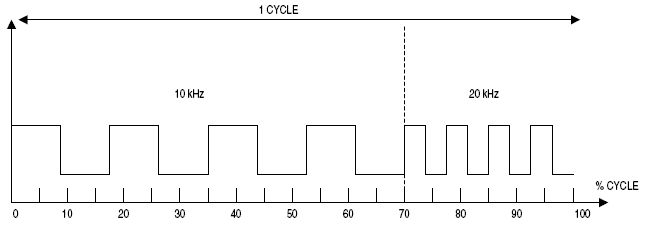
Figure 2. Dithering waveforms
The HRP provides frequency dithering between two frequencies whose period differ by one bus clock cycle. When the HRP is supplied with an 8-MHz clock, the difference in period values is 125 ns. The HRP provides a programmable number of dithering steps up to a maximum of 32 steps. This results in a frequency resolution of 125/32 = 3.906 ns with an 8-MHz clock. The HRP can also perform duty cycle dithering with identical step resolution as the frequency dithering option – 125/32 = 3.906 ns.